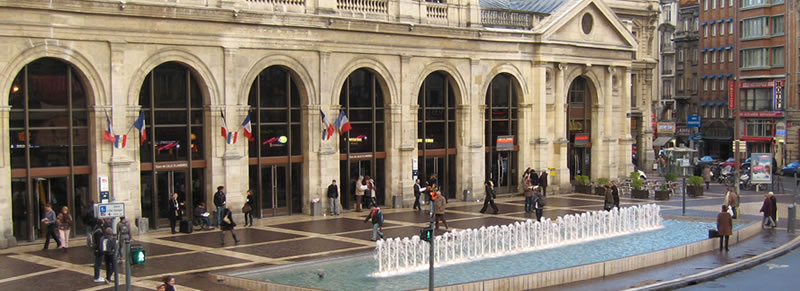
Lille has two main stations- Gare Lille Flanders for trains throughout the city, and Gare Lille-Europe which also operates TGV, Eurostar and other high speed services. Trains between Ebbsfleet and Lille run around 8 times a day Monday-Friday, and 12 times a day Saturdays and Sundays.
Eurostar
trains between Ebbsfleet International and Lille have average journey times of 1 hour, 20 minutes, making it even faster and more convenient to reach via high speed rail. The best time to visit is late spring or early summer, as the warm weather makes it so popular.
Lille is the fourth largest city in France, is situated in the north and is close to the border with Belgium with around 220,000 inhabitants. Summer time in Lille between June and August is the warmer time to visit with average temperatures around 68°F, 20°C. In winter time temperatures can reach 32° F (0°C).
In 2004, it was designated a European Culture Capital, and since has been an important tourist destination with a well preserved history. Shopping and markets are an important part of life in Lille, here a mixture of traditional shops and more international shops can be found.
Points of interest
La Vieille Bourse
The finest building in the city, built around 1652 during which period Lille was part of the Netherlands. Above the entrance gate are two lions, a symbol of this, and in the centre is the "fleur de lys", the city's emblem. Inside the cloister there are usually bookstalls with interesting engraved designs on the stone.
Palais des Beaux-Arts
A 19th century building which holds Lille's renowned museum of fine arts. The gallery features examples of work by Goya, Donatello, Raphael and Rubens.
Hospice Comtesse
Originally built as a hospital in 1237, it remained in working operation until 1939 when it became a museum containing tapestries, paintings, wood sculptures all from this region of France.
The Open Air Museum
Lille's living museum, which is a recreation of a local village including thatched cottages, rural craft workshops, seed barns and traditional farmhouses.
Attractions
L'Opéra, opened in 1923 replacing another theatre built in 1785 which burnt down.
One of the few surviving Flanders buildings founded by the Countess of Flanders, Jeanne de Constantinople, now an art museum.
The goddess (holding a cannon fuse in her right hand), which can be seen throughout the city such as the Grand Place or “Place du General de Gaulle”, represents one of the proudest moments of the city's history. In September 1792 Lille was part of France, but the city was surrounded by 35,000 Austrian soldiers, though it refused to surrender. Lille managed to hold out and the siege was eventually lifted.
Hospice Comtesse
Originally built as a hospital in 1237, it remained in working operation until 1939 when it became a museum containing tapestries, paintings, wood sculptures all from this region of France.... Lille, France
La Vieille Bourse
The finest building in the city, built around 1652 during which period Lille was part of the Netherlands. Above the entrance gate are two lions, a symbol of this, and in the centre is the "fleur de lys", the city's emblem. Inside the cloister there are usually bookstalls with interesting engraved designs on the stone.... Lille, France
Palais des Beaux-Arts
A 19th century building which holds Lille's renowned museum of fine arts. The gallery features examples of work by Goya, Donatello, Raphael and Rubens.... Lille, France
The Open Air Museum
Lille's living museum, which is a recreation of a local village including thatched cottages, rural craft workshops, seed barns and traditional farmhouses.... Lille, France